Monday, February 14, 2011
DCS: A-10C Warthog - Dropping Bombs
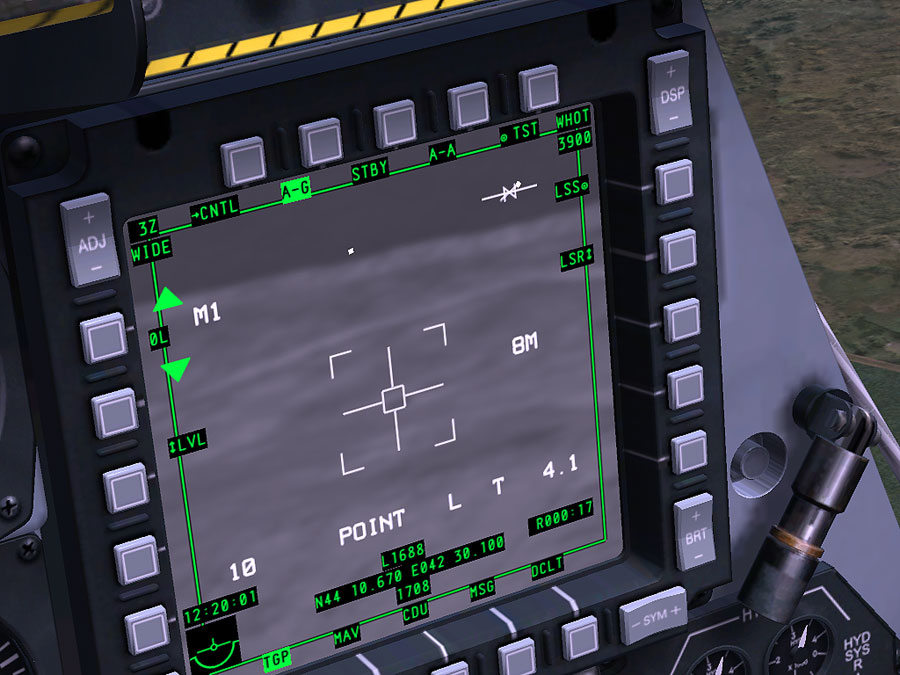
I'm feeling particularly courageous these days and decided that I should start a serious and methodical learning regime on the A-10's ordnance usage.
The DCS series pilot's manuals have not worked out very well for me. They are very detailed, but I just can't learn from them.
So I am reading forums checking YouTube videos and cross-referencing with the manual. Not so methodical, but well at least to figure out what I don't know. Wait! That is an easy one: I know nothing! :)
I'm totally hooked with this simulator. I love flying it, I love the avionics, the targeting system ... I feel all geeked up with all the systems and button presses.
Yesterday I erased my old controllers profile. I'm using a CH Products HOTAS/Rudder Pedals combo and I mapped these controllers more or less in line with the real A-10 HOTAS. The stick was easy as it is very similar to the real one, at least button-wise. The CH Throttle not so charming, but oh well ... The idea is that if the realA-10 HOTAS is mapped that way, it must be very close to the optimal.
So, let me post here a video from a guy nicknamed ExcessiveHeadSpace. Absolutely great videos on DCS A-10. Make sure to visit his videos at YouTube and leave some feedback. He deserves a big thank you!
Cheers,
Sunday, February 13, 2011
DCS Black Shark - Tunnel Vision
The game: DCS Black Shark
The tactical situation: a flight of two Ka-50 is prepping by fire the route that land forces will use to advance through insurgent-controlled territory.
The topic: sensors are good, but watching out of the cockpit is what keeps you alive.
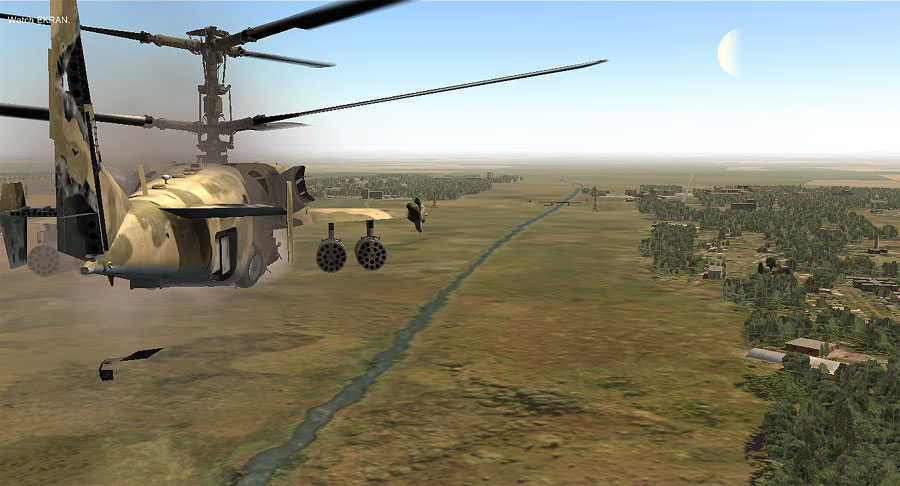
The enemy system that hit me was another ZU-23-2. I was a fool letting my flight so close to the built up area. But while reviewing the mission track I could see a first burst of AAA not hitting me. If I would be watching out through the window instead of the Shkval screen, I could have avoided the enemy fire.
Cheers,
The tactical situation: a flight of two Ka-50 is prepping by fire the route that land forces will use to advance through insurgent-controlled territory.
The topic: sensors are good, but watching out of the cockpit is what keeps you alive.
![]() |
| We stop well ahead every built up area to scan ahead. |
![]() |
| Found a truck-mounted ZU-23-2 near the road. We fired at it, but the range was too high (3.4 km). |
![]() |
| In search for a better angle of fire and a better range, we fly parallel to the road with the threat at our left. |
![]() |
| At the new firing position, the range is still high. But the field of fire is extremely clear. |
![]() |
| The new firing position and my sustained staring at the SHKVAL got us too close to a new built up are. Another AAA position fired at us and hit me. |
![]() |
| The shark is bleeding smoke as I pull it out of trouble. The enemy AAA keeps shooting at us: see the tracer just below the rocket pods in my left pylon. |
![]() |
| With all this damage, I'm surprised I could fly the shark out of the enemy fire. |
![]() |
| Emergency landing. This is not going to look good in my pilot's file. |
Cheers,
My TrackIR 4 is Dead! Long Live my TrackIR 5!
What a week, folks!
Work was insufferable. My old Windows XP machine stopped booting up after I tried to install something. My TrackIR 4 died. When it rains, it pours.
The show must go on, though. I finally pulled out that mega order at work, I re-installed XP at the missbehaved machine (still have to un-license and reinstall some games) and got myself a TrackIR 5.
TrackIR 5 is noticeable better than TrackIR 4 in terms of response and accuracy. Yet I don't recommend upgrading if your TrackIR 4 is still working fine.
What went wrong with my TrackIR 4? I will never now. I noticed it not responding very well two weeks ago. Maybe I should have un-plugged it while I was not using it (sometimes I stay for hours in the computer and I wonder if these things overheat).
Wanna hear something good about a games company?
GoGamer.com! I ordered my TrackIR5 early on Monday 7th. Their website said it was available and that would ship withing 24 hours. I payed for a FedEx 2 day shipping. During the afternoon of Tuesday 8th, I write an e-mail to them asking why my order has not shipped (order status in their website was "processing") and they answered something like "yeah, yeah, it will ship today". Late Tuesday 8th, the order is still listed "processing" and I have no hopes of this thing getting in a long time. Wednesday 9th in the afternoon I get an e-mail telling me that the order has shipped. I track the package at FedEx and I found out the package was already delivered that morning! Meh! These GoGamer guys are men of action and not paper-pushers. They charged my credit card just today, almost a week later. Odd. But my TrackIR 5 was here just in the promised time span.
Cheers,
Work was insufferable. My old Windows XP machine stopped booting up after I tried to install something. My TrackIR 4 died. When it rains, it pours.
The show must go on, though. I finally pulled out that mega order at work, I re-installed XP at the missbehaved machine (still have to un-license and reinstall some games) and got myself a TrackIR 5.
TrackIR 5 is noticeable better than TrackIR 4 in terms of response and accuracy. Yet I don't recommend upgrading if your TrackIR 4 is still working fine.
What went wrong with my TrackIR 4? I will never now. I noticed it not responding very well two weeks ago. Maybe I should have un-plugged it while I was not using it (sometimes I stay for hours in the computer and I wonder if these things overheat).
Wanna hear something good about a games company?
GoGamer.com! I ordered my TrackIR5 early on Monday 7th. Their website said it was available and that would ship withing 24 hours. I payed for a FedEx 2 day shipping. During the afternoon of Tuesday 8th, I write an e-mail to them asking why my order has not shipped (order status in their website was "processing") and they answered something like "yeah, yeah, it will ship today". Late Tuesday 8th, the order is still listed "processing" and I have no hopes of this thing getting in a long time. Wednesday 9th in the afternoon I get an e-mail telling me that the order has shipped. I track the package at FedEx and I found out the package was already delivered that morning! Meh! These GoGamer guys are men of action and not paper-pushers. They charged my credit card just today, almost a week later. Odd. But my TrackIR 5 was here just in the promised time span.
Cheers,
Monday, February 7, 2011
ArmA 2 Operation Arrowhead British Armed Forces - Checkpoint Repels Insurgent Attack With .50 Cals
The game: ArmA 2 Operation Arrowhead British Armed Forces
The situation: a patrol section (+) manning an unfinished checkpoint is caught by surprise by insurgent forces.
The topic: in open terrain the .50 cal is king. Hone your HMG techniques of fire, lads!
The engineers came, built a half-assed checkpoint and left with the promise of finishing it up the following day. Checkpoint North was born out of wire, earthen parapets, small sandbagged bunkers and the willingness of the British soldier to do whatever it takes to accomplish a mission. Our command post/living quarters was a nice change, though. We have been sleeping near our Jackals for quite a while and having a roof over our heads was a welcomed change in the routine.
The reasons why we ended manning checkpoint North with so few assets are hard to justify. Our patrols platoon was conducting presence patrols in the area when the order to set up a checkpoint came in. Our CO decided not to interrupt such patrols because he got HUMINT about "something out of place with the insurgents cell phone traffic". We ended up at checkpoint North with just three Jackals (three teams or a reinforced section). A platoon should not be split when the enemy is in the bushes ... This is true since the time of the Boer Wars.
It was while following a HUMINT tip at a village south of the checkpoint when the distant sound of an IED and the ensuing frantic radio calls reached my 5 men team. We jumped in our Jackal and rushed towards the checkpoint trying to sort out what was going on.
As we approached the chekcpoint, we could see the smoking trails of SPG-9 recoilless guns fired at the two Jackals that were already in position. There was only two vehicle fighting pits at the checkpoint and we needed a hull down position immediately. The Jackal is moderately tall, and hard to "hull down". Out of desperation I drove our vehicle behind the cover of the command post.
Cheers,
The situation: a patrol section (+) manning an unfinished checkpoint is caught by surprise by insurgent forces.
The topic: in open terrain the .50 cal is king. Hone your HMG techniques of fire, lads!
The engineers came, built a half-assed checkpoint and left with the promise of finishing it up the following day. Checkpoint North was born out of wire, earthen parapets, small sandbagged bunkers and the willingness of the British soldier to do whatever it takes to accomplish a mission. Our command post/living quarters was a nice change, though. We have been sleeping near our Jackals for quite a while and having a roof over our heads was a welcomed change in the routine.
![]() |
| The entrance to checkpoint North. |
![]() |
| Rush hour at checkpoint North. The line is a whooping 10 cars long. |
![]() |
| The search area of checkpoint North. We didn't even have the proper search tools. |
![]() |
| On the right side of the road, we placed a Jackal in a firing position overlooking the main approach to the checkpoint. The command post/living quarters can be seen on the left. |
![]() |
| Same thing on the left side of the road. |
It was while following a HUMINT tip at a village south of the checkpoint when the distant sound of an IED and the ensuing frantic radio calls reached my 5 men team. We jumped in our Jackal and rushed towards the checkpoint trying to sort out what was going on.
![]() |
| The smoke and fire in the distant checkpoint ... Nothing good is coming out of this thing. |
![]() |
| Hull down, but with an exposed gunner. Such is the life of the lightly armored vehicle crews. |
![]() |
| The view from our vehicle. In the distance, insurgents pour out of an assortment of vehicles. |
![]() |
| The AI does a moderately good job shooting the L111A1, but I eventually I had to man the thing. Note the sandbags of the roof of the command post. |
![]() |
| We eventually abandoned the relative safety of the checkpoint and moved up the road to clear it. In this image, the Jackal covers us with the .50 cal. |
![]() |
| Never underestimate the power of the .50 cal. |
Cheers,
Wednesday, February 2, 2011
Maneuver Warfare: A Wargamer's Notebook - OODA Cycles - In the Air: Sabres vs Migs
This series of blog entries are about the so-called "maneuver warfare" as explained by William Lind. The writings of Robert Leonhard will also be included. I claim neither expertise in the subject nor devotion to this way of waging wars and thus I am not trying to convert you into anything. This series is not an analysis or a review of all ideas about maneuver warfare but rather some explorations about the topic based on computer war games and simulations. Future entries will be delivered based in readership.
In the previous entry, I mentioned how John Boyd got the idea of the OODA cycles from the air combat realities of the Korean War. Apparently, the F-86 Sabre had no advantage over the Mig-15 in thrust, turn or climb rates. It was the ability of the F-86 Sabre to quickly transition between maneuvers what made the difference against the Mig-15.
In this entry, I fly through the virtual skies of North Korea looking for some edu-fun-meint.
The choice of flight simulator was easy: Rowan's Mig Alley. I don't think any mod out there for more modern combat flight simulators can replicate the dogfight experience of the good ole Mig Alley. A thing I never got over with fan-made mods to flight simulators is the lack of information about their flight models. Since flight models are really very important for this entry, I just sticked with Mig Alley. BTW, this flight simulator (ugly as it looks by today's standards) has a lot of personality. Maybe I should write a few more entries about it.
So, I went on and flew the Sabre and the Mig in empty skies. On the issue of maneuver transitions: yes, I can invert, roll and shake the stick with an almost immediate response in the Sabre. Not so fast with the Mig-15. Check, issue is closed.
Can the fast transitions of the Sabre translate in faster observation-orientation-decision-action cycles that can be used to gain an advantage? Seoul, we have a problem ... Of the OODA cycle, 3 out of 4 steps (observation, orientation and decision) depend exclusively on the man and just one (action) step partially depends on the machine. Yours truly is a terrible combat pilot ...
Even when the Mig-15 was mentioned above in having the advantage in sustained performance, this advantage is not gigantic. For air-combat purposes, the Sabre and the Mig can be considered as "similar aircraft". I experienced this in the flight simulator: flying the Sabre in turn-and-burn dogfights (angles fights would be the academic term), and in particular at the very end of flat scissors maneuvers, I frequently ended up in a head to head zoom ins. In other words, both aircraft can turn almost at the same rate and with the same radius.
I still have to work my flying skills to take advantage of the supposedly faster transitions of the Sabre. All I can report today is how I took advantage of a bad OODA cycle of a Mig-15's pilot.
So here it goes: a mano a mano with a Mig-15 (computer opponent set to "hero", the maximum skill available).
Cheers,
In the previous entry, I mentioned how John Boyd got the idea of the OODA cycles from the air combat realities of the Korean War. Apparently, the F-86 Sabre had no advantage over the Mig-15 in thrust, turn or climb rates. It was the ability of the F-86 Sabre to quickly transition between maneuvers what made the difference against the Mig-15.
In this entry, I fly through the virtual skies of North Korea looking for some edu-fun-meint.
The choice of flight simulator was easy: Rowan's Mig Alley. I don't think any mod out there for more modern combat flight simulators can replicate the dogfight experience of the good ole Mig Alley. A thing I never got over with fan-made mods to flight simulators is the lack of information about their flight models. Since flight models are really very important for this entry, I just sticked with Mig Alley. BTW, this flight simulator (ugly as it looks by today's standards) has a lot of personality. Maybe I should write a few more entries about it.
So, I went on and flew the Sabre and the Mig in empty skies. On the issue of maneuver transitions: yes, I can invert, roll and shake the stick with an almost immediate response in the Sabre. Not so fast with the Mig-15. Check, issue is closed.
Can the fast transitions of the Sabre translate in faster observation-orientation-decision-action cycles that can be used to gain an advantage? Seoul, we have a problem ... Of the OODA cycle, 3 out of 4 steps (observation, orientation and decision) depend exclusively on the man and just one (action) step partially depends on the machine. Yours truly is a terrible combat pilot ...
Even when the Mig-15 was mentioned above in having the advantage in sustained performance, this advantage is not gigantic. For air-combat purposes, the Sabre and the Mig can be considered as "similar aircraft". I experienced this in the flight simulator: flying the Sabre in turn-and-burn dogfights (angles fights would be the academic term), and in particular at the very end of flat scissors maneuvers, I frequently ended up in a head to head zoom ins. In other words, both aircraft can turn almost at the same rate and with the same radius.
![]() |
| Head to head zoom in. Scary stuff ... |
I still have to work my flying skills to take advantage of the supposedly faster transitions of the Sabre. All I can report today is how I took advantage of a bad OODA cycle of a Mig-15's pilot.
So here it goes: a mano a mano with a Mig-15 (computer opponent set to "hero", the maximum skill available).
![]() |
| A Mig-15 in my tail ... Just another day in the office. |
![]() |
| The Mig-15 is turning with me. |
![]() |
| He tries hard to saddle. Here is to hope that the Mig-15 overshoots. |
![]() |
| The turns into me, I turn into him ... A tad late but that's what the books say I am supposed to do. |
![]() |
| The Mig-15 is trying to get away. I struggle to regulate my airspeed to a perfect closure rate that avoids an overshoot. |
![]() |
| I let him to pass by my aircraft. He goes down in a gentle spiral turn. It's a confirmed kill. |
Cheers,
Sunday, January 30, 2011
Air Assault Task Force - Mini Thunder Run
The game: Air Assault Task Force
The scenario: a US Cavalry company reinforced with engineer assets is pushing into Baghdad and trying to spoil an ongoing Iraqi Army withdrawal.
What I want to share: fire and maneuver while on the run with a platoon of M1A2 Abrams tanks.
I know, I know ... urban terrain and tanks do not mix well. But I'm claiming extreme time constrains. An infantry platoon with a "clear" order would take no less than two hours to clear that amount of terrain.
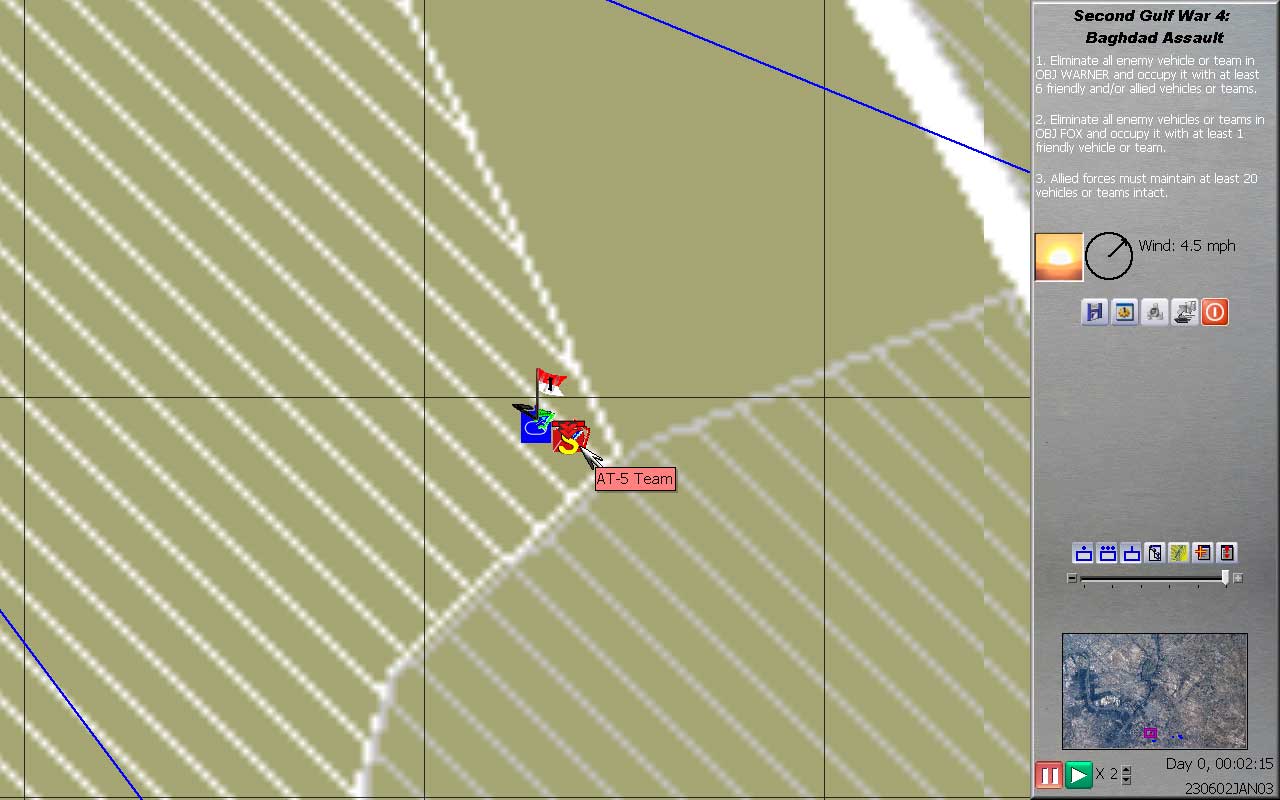
The first AT-5 team is destroyed and I move my units right away. Very important: re-issue a "suppress" order in front of the First Platoon, so they fire away against any hostiles they find on their way.
The scenario: a US Cavalry company reinforced with engineer assets is pushing into Baghdad and trying to spoil an ongoing Iraqi Army withdrawal.
What I want to share: fire and maneuver while on the run with a platoon of M1A2 Abrams tanks.
I know, I know ... urban terrain and tanks do not mix well. But I'm claiming extreme time constrains. An infantry platoon with a "clear" order would take no less than two hours to clear that amount of terrain.
![]() |
| Click the image for an expanded view. To make sure each tank can support by fire the rest of the platoon I select "none" as the formation and drag the tanks very close to each other. |
![]() |
| Click the image for an expanded view. I had to move the Platoon really close to identify the enemy position. Now with the unit identified, I can issue a "TRP" order to the platoon so they use their fires to destroy the enemy unit. This AT-5 team, if un-suppressed, would kick our asses from 3 kilometers away. So watch it. |
The first AT-5 team is destroyed and I move my units right away. Very important: re-issue a "suppress" order in front of the First Platoon, so they fire away against any hostiles they find on their way.
Saturday, January 29, 2011
Maneuver Warfare: A Wargamer's Notebook - OODA Cycles - A Brief Intro
This series of blog entries are about the so-called "maneuver warfare" as explained by William Lind. The writings of Robert Leonhard will also be included. I claim neither expertise in the subject nor devotion to this way of waging wars and thus I am not trying to convert you into anything. This series is not an analysis or a review of all ideas about maneuver warfare but rather some explorations about the topic based on computer war games and simulations. Future entries will be delivered based in readership.
OODA is an acronym for:
The OODA cycle is a deep and far reaching concept. In the present day is used in almost every competitive environment, including business. Unfortunately is often trivialized and misinterpreted. I already mentioned the popular interpretation of it as a "loop" rather than a cycle. For a complete discussion please check Science, Strategy and War by Frans Osinga (the most complete study of Boyd's military theories). A link to this book is provided below.
No less important than the ideas themselves are the ways these come to life. John Boyd's life and the origin of his ideas are described in Robert Coram's biography (link provided below). Boyd's intellectual pursuit on land warfare originated from the following observation about the kill ratios during the air war over Korea: the Mig-15's specifications (ceiling, max speed, thrust, climb rate, etc) toped the ones of the F-86 Sabre, yet the Sabres shot down more Migs.
The quest for the answer to this question is really fascinating. By this time, Boyd was perfecting his energy maneuverability theory (a theory about air combat that is another outstanding contribution) but the numbers from that theory favored the Migs. It had to be the men flying those aircrafts. Training? Nah, the North-Koreans were not bad fighter pilots and their training was almost identical to the one of the Soviets. Boyd's interpretation of the kill ratios was that the F-86 pilots could see better (the F-86 canopy had a better field of view) and change maneuvers faster because of the hydraulic controls of the aircraft (the Mig-15 had sluggish controls that resulted in a delayed aircraft response). In short, the F-86 pilots could see better (observe, orient, decide) and have their aircraft to respond faster to their decisions (action). A shorter OODA cycle.
These ideas are so deep that a whole dedicated blog would just scratch the surface. For the sake of brevity, I will just leave to you the task of exploring them. But please comment for inaccuracies above, ideas that you want to add just plain fun of discussion.
And now, let's go for some fun themed along the lines of the paragraphs above. Stay tuned.
Cheers,
Veni, vidi, vici.
Shortest OODA cycle ever.As the theories of other influential military thinkers, the thoughts of John Boyd are commonly summed up in a short catch word or phrase. In this case, the OODA loop. Not much of a loop but rather a cycle, OODA cycles are the central piece of Boyd's theory and the very foundation stone of the maneuver warfare school of thought.
OODA is an acronym for:
- Observation
- Orientation
- Decision
- Action
The OODA cycle is a deep and far reaching concept. In the present day is used in almost every competitive environment, including business. Unfortunately is often trivialized and misinterpreted. I already mentioned the popular interpretation of it as a "loop" rather than a cycle. For a complete discussion please check Science, Strategy and War by Frans Osinga (the most complete study of Boyd's military theories). A link to this book is provided below.
No less important than the ideas themselves are the ways these come to life. John Boyd's life and the origin of his ideas are described in Robert Coram's biography (link provided below). Boyd's intellectual pursuit on land warfare originated from the following observation about the kill ratios during the air war over Korea: the Mig-15's specifications (ceiling, max speed, thrust, climb rate, etc) toped the ones of the F-86 Sabre, yet the Sabres shot down more Migs.
The quest for the answer to this question is really fascinating. By this time, Boyd was perfecting his energy maneuverability theory (a theory about air combat that is another outstanding contribution) but the numbers from that theory favored the Migs. It had to be the men flying those aircrafts. Training? Nah, the North-Koreans were not bad fighter pilots and their training was almost identical to the one of the Soviets. Boyd's interpretation of the kill ratios was that the F-86 pilots could see better (the F-86 canopy had a better field of view) and change maneuvers faster because of the hydraulic controls of the aircraft (the Mig-15 had sluggish controls that resulted in a delayed aircraft response). In short, the F-86 pilots could see better (observe, orient, decide) and have their aircraft to respond faster to their decisions (action). A shorter OODA cycle.
These ideas are so deep that a whole dedicated blog would just scratch the surface. For the sake of brevity, I will just leave to you the task of exploring them. But please comment for inaccuracies above, ideas that you want to add just plain fun of discussion.
And now, let's go for some fun themed along the lines of the paragraphs above. Stay tuned.
Cheers,
Thursday, January 27, 2011
SITREP: Pinned Down by Day Job!
I'm itching to write more. So many ideas, so many games!
Unfortunately, my day job has been crazy these last two weeks. It's easing up, though.
Still in the fight. Thanks for reading my mumblings!
Cheers,
Unfortunately, my day job has been crazy these last two weeks. It's easing up, though.
Still in the fight. Thanks for reading my mumblings!
Cheers,
Sunday, January 23, 2011
Squad Battles Moder War - The Taliban Who Wouldn't Die
The Game: Squad Battles Modern War
The Scenario: Dahaneh (Scenario A)
The Mission: An un-supported heliborne insertion to investigate a suspected Taliban compound. Forces available are one US Marines Rifle Platoon plus a US Marines Weapons Platoon (-). No indirect fire support, no close air support available. Forces to be inserted with three CH-53 Sea Stallion helicopters armed with .50 cals. Time available for the mission is one hour of simulated time or 12 turns.
What's up? An assault on a single sniper position by a US Marine squad came at the expense of one grunt.
Enough to make nervous even the toughest Marine, this mission has a lot to comment about and learn from. Just to mention two:
We just started the fight, and we have only 30 minutes left for the whole mission!
Cheers,
The Scenario: Dahaneh (Scenario A)
The Mission: An un-supported heliborne insertion to investigate a suspected Taliban compound. Forces available are one US Marines Rifle Platoon plus a US Marines Weapons Platoon (-). No indirect fire support, no close air support available. Forces to be inserted with three CH-53 Sea Stallion helicopters armed with .50 cals. Time available for the mission is one hour of simulated time or 12 turns.
What's up? An assault on a single sniper position by a US Marine squad came at the expense of one grunt.
Enough to make nervous even the toughest Marine, this mission has a lot to comment about and learn from. Just to mention two:
- Unsecured, non-prepped by fire helicopter landing zones. During the Russo-Afghan War, the Russians developed a knack for surprise heliborne insertions damn close to suspected enemy held towns. Many times the surprise turned out to be that the Mujahideen were ready and waiting in ambush. In this scenario, given the lack of reasonable fire support and the meager forces available, I had to land just 200 meters outside Dahaneh because landing away from the town and thus approaching through the open ground would be time consuming and the enemy would be on alert by the time we set up a scheme of fire and maneuver.
- The slugfest of advancing through built up areas. How demanding on time, sweat and blood urban combat is. We landed in the southeast corner of our sector and quickly moved west to gain a foothold within the protection of the built-up area. Plan was then to gain our way north, advancing in a left-leaning wedge to provide some sort of support on our west flank.
We just started the fight, and we have only 30 minutes left for the whole mission!
Cheers,
Monday, January 17, 2011
Gary Grigsby's War in the East - Review
This review does not include a detailed description of game features that I think is important for your decision of buying this game or not. Please take a look at my AAR for a closer look of such game features: Part 1, Part 2 and Part 3. Thanks!
A non-scary monster game
War in the East is a bold game with an ambitious goal. It is the story of the biggest operation in military history told in 2113 counters and 25760 hexes. Based on its scope, depth and amount of moving parts, this game qualifies as a so-called "monster game" and is apparently geared exclusively towards the hardcore audience that enjoys this type of games. However it is surprisingly approachable and worth a look by all war gamers interested in operational warfare and/or the Eastern Front.
Headquarters at your cursor tip
War in the East is a war game encompassing the whole WWII Eastern Front and focusing at the military strategic and operational level of war (there is no diplomacy or other politico/socio-strategic options as in games like Hearts of Iron). The game's smallest moveable units are divisions (or regiments if you break divisions down), with the occasional smaller-sized combat support unit. The terrain is divided in hexagons of 10 miles and each turn lasts one week of simulated time. The game flows depending on the player's actions and the progress of the war feels realistic. If everything goes according to history, the player is faced with the daunting task of invading or defending Russia (June 1941-November 1942), lead the reversal to an strategic offensive (as the Russians) or to an strategic defensive (as the Germans) (December 1942-December 1943) and finally leading the offensive (as the Russians) or the defense of Germany (1944 to 1945). To wage this gigantic conflict, the player has an sizeable amount of data to consider and a comparable amount of decisions to make. Data presentation in War in the East is simply fantastic, one of the best organized and interactive interfaces I've ever seen. It has hiccups here and there (for example I couldn't figure out is how to know how many air assets for close air support I have available before a ground attack), but overall is lean, functional and very well thought. The decision-making is mouse driven off course, and the clicking needed to put the command decisions in action is very straightforward. I am not talking about the obvious clicks needed to attack the enemy, but decisions like reinforce a formation, put it into reserve, repair a railroad, provide air supply to a troubled unit, change the leader of a division, corp or army, etc.
Hexes and turns for the age of Google Earth and real time-everything
Jumping over the learning curve: drop that manual and fight!
I spared myself of the chore or reading the manual from cover to cover. My grognardy urge of checking and knowing every single rule and mechanism of the game was replaced early on by a desire to fight this virtual war, because it is obvious that the game's message was the war and not the way the game is designed. I don't want to be a lawyer perusing the rules of a virtual war of precise clockwork inner workings but rather want to be a general leading men in the marshes of the unpredictable. The majority of individual rules and mechanics of the game that I've checked are pretty much like the ones found in other turn-hex-based war games. Your mileage may vary but consider this: how many of the total available Microsoft Word's menu items/buttons have you ever used? Has your relatively limited knowledge of all the commands available ever stopped your from writing a good story? To the spirit of these two questions, I learnt quite a bit about this game by having a clear understanding of what I wanted to accomplish in the military realm (objectives, lines of operation, shaping or decisive operations) and then going back to the manual to see what should done in terms of game rules and mechanics. War in the East is a tool to simulate the WWII Eastern Front, and every time I played the virtual war came out as the result of good or bad military command decisions and not as the by-product of the intricacies of the game engine.
Don't judge a game by its level of detail
War in the East is also one of the first games where complexity and high level of detail was not thrown at me like hot potatoes. In some War in the East game session somewhere in the world, a gamer is busy checking how many gallons of fuel, rounds of ammunition and number of grenadier squads the 7th Panzer Division has available and I'm sure he will put that information to good use. In my war room, I focus on lines of operation, mobility corridors for anything bigger than a Corps and I wonder if air superiority is all that necessary at this time of the operation. The other gamer is not being overzealous and I am not being careless. We are enjoying the same game from different perspectives and with different styles. I don't want to fool you into thinking that there will be no pain in moving a thousand counters at every turn of the big scenarios, but also I don't want you to think that all the detailed information the game can feed you needs to be acted upon. A big part of being a leader is to figure out what information is important.
Pushing three million men to victory
The big scenarios featuring the whole theater of operations are not to be played quickly. You couldn't even if you wanted to. The amount of counter pushing is big. It took me some thirty minutes just to move every German unit in the Barbarossa scenario. That is not counting the time to identify formations and to decide and sort objectives. Turn resolution in scenarios that cover the whole war take also some serious time. The big scenarios are more like a project you work on through several gaming sessions. If you are not into such type of commitments, you will find smaller scenarios with lots of game play value. Yet after a while you will agree with me that War in the East sorely needs more of the smaller scenarios featuring operations during the 1942-1945 time period.
Specs of the new car great, driving it feels like ...
.. being a military strategist, an operational planner, the organizer of things sized beyond the grasp of most mortals, the rallying leader in the eve of certain destruction. This is like having command over the collective fighting spirit of two nations in the ultimate duel for survival.
Final thoughts
Some people see an unsurmountable mountain in the sheer size of this game. I see opportunities. Others gasp at its price. I rejoice at the prospect of years of quality gaming. Whatever your take may be, this is not a war game that will go un-noticed in the history of the hobby.
Cheers,

A non-scary monster game
War in the East is a bold game with an ambitious goal. It is the story of the biggest operation in military history told in 2113 counters and 25760 hexes. Based on its scope, depth and amount of moving parts, this game qualifies as a so-called "monster game" and is apparently geared exclusively towards the hardcore audience that enjoys this type of games. However it is surprisingly approachable and worth a look by all war gamers interested in operational warfare and/or the Eastern Front.
Headquarters at your cursor tip
War in the East is a war game encompassing the whole WWII Eastern Front and focusing at the military strategic and operational level of war (there is no diplomacy or other politico/socio-strategic options as in games like Hearts of Iron). The game's smallest moveable units are divisions (or regiments if you break divisions down), with the occasional smaller-sized combat support unit. The terrain is divided in hexagons of 10 miles and each turn lasts one week of simulated time. The game flows depending on the player's actions and the progress of the war feels realistic. If everything goes according to history, the player is faced with the daunting task of invading or defending Russia (June 1941-November 1942), lead the reversal to an strategic offensive (as the Russians) or to an strategic defensive (as the Germans) (December 1942-December 1943) and finally leading the offensive (as the Russians) or the defense of Germany (1944 to 1945). To wage this gigantic conflict, the player has an sizeable amount of data to consider and a comparable amount of decisions to make. Data presentation in War in the East is simply fantastic, one of the best organized and interactive interfaces I've ever seen. It has hiccups here and there (for example I couldn't figure out is how to know how many air assets for close air support I have available before a ground attack), but overall is lean, functional and very well thought. The decision-making is mouse driven off course, and the clicking needed to put the command decisions in action is very straightforward. I am not talking about the obvious clicks needed to attack the enemy, but decisions like reinforce a formation, put it into reserve, repair a railroad, provide air supply to a troubled unit, change the leader of a division, corp or army, etc.
Hexes and turns for the age of Google Earth and real time-everything
Every now and then I bump into titles that remind me that the turn and hexagon-based war game format is not exhausted but rather that I am exhausted of some other games using the format in a way that destroy the war-waging experience beyond recognition. War in the East is a turns and hexes war game but somehow I felt the game play as less constrained by such partitions in time and space.There are abstractions in War in the East, but every command decision I made at the corps level and above were done without ever thinking of them.
Jumping over the learning curve: drop that manual and fight!
I spared myself of the chore or reading the manual from cover to cover. My grognardy urge of checking and knowing every single rule and mechanism of the game was replaced early on by a desire to fight this virtual war, because it is obvious that the game's message was the war and not the way the game is designed. I don't want to be a lawyer perusing the rules of a virtual war of precise clockwork inner workings but rather want to be a general leading men in the marshes of the unpredictable. The majority of individual rules and mechanics of the game that I've checked are pretty much like the ones found in other turn-hex-based war games. Your mileage may vary but consider this: how many of the total available Microsoft Word's menu items/buttons have you ever used? Has your relatively limited knowledge of all the commands available ever stopped your from writing a good story? To the spirit of these two questions, I learnt quite a bit about this game by having a clear understanding of what I wanted to accomplish in the military realm (objectives, lines of operation, shaping or decisive operations) and then going back to the manual to see what should done in terms of game rules and mechanics. War in the East is a tool to simulate the WWII Eastern Front, and every time I played the virtual war came out as the result of good or bad military command decisions and not as the by-product of the intricacies of the game engine.
Don't judge a game by its level of detail
War in the East is also one of the first games where complexity and high level of detail was not thrown at me like hot potatoes. In some War in the East game session somewhere in the world, a gamer is busy checking how many gallons of fuel, rounds of ammunition and number of grenadier squads the 7th Panzer Division has available and I'm sure he will put that information to good use. In my war room, I focus on lines of operation, mobility corridors for anything bigger than a Corps and I wonder if air superiority is all that necessary at this time of the operation. The other gamer is not being overzealous and I am not being careless. We are enjoying the same game from different perspectives and with different styles. I don't want to fool you into thinking that there will be no pain in moving a thousand counters at every turn of the big scenarios, but also I don't want you to think that all the detailed information the game can feed you needs to be acted upon. A big part of being a leader is to figure out what information is important.
Pushing three million men to victory
The big scenarios featuring the whole theater of operations are not to be played quickly. You couldn't even if you wanted to. The amount of counter pushing is big. It took me some thirty minutes just to move every German unit in the Barbarossa scenario. That is not counting the time to identify formations and to decide and sort objectives. Turn resolution in scenarios that cover the whole war take also some serious time. The big scenarios are more like a project you work on through several gaming sessions. If you are not into such type of commitments, you will find smaller scenarios with lots of game play value. Yet after a while you will agree with me that War in the East sorely needs more of the smaller scenarios featuring operations during the 1942-1945 time period.
Specs of the new car great, driving it feels like ...
.. being a military strategist, an operational planner, the organizer of things sized beyond the grasp of most mortals, the rallying leader in the eve of certain destruction. This is like having command over the collective fighting spirit of two nations in the ultimate duel for survival.
Final thoughts
Some people see an unsurmountable mountain in the sheer size of this game. I see opportunities. Others gasp at its price. I rejoice at the prospect of years of quality gaming. Whatever your take may be, this is not a war game that will go un-noticed in the history of the hobby.
Cheers,
Subscribe to:
Posts (Atom)