Just in case you haven't read the news elsewhere, 2by3 and Matrix Games have released today the massive War in the East war game.
I am sure I'm going to play this one. But given the pile of other stuff I have to do, the question is when ...
War gaming is dead, yeah right! :) Good times!
Cheers,
Tuesday, December 7, 2010
Monday, December 6, 2010
Red Pill's First Video! - Gameplay footage from the highly anticipated naval war game
This just in from Warfaresims.com. Check out the timeline at the original post there. For a better viewing, it is recommended to run the video in HD and at full screen.
Cheers,
Cheers,
Sunday, December 5, 2010
Revolution Under Siege - Operational Blunder
I should be writing a review of this game ... Only if I could stop having fun with this thing.
Cheers,
EDIT: Corrected size for better viewing. Check it out at YouTube if you have issues.
Cheers,
EDIT: Corrected size for better viewing. Check it out at YouTube if you have issues.
Friday, December 3, 2010
Panzer Campaigns Goes Downloadable - Kharkov 43
Panzer Campaigns, the great series from John Tiller has gone the digital download route. The first title available is Kharkov 43 and its from John Tiller's website and store.
All other John Tiller titles are available from HPS Simulations at this time. It will be interesting to see where this goes. Has John Tiller parted from HPS?
Kharkov 43 has some minor differences from the other Panzer Campaigns titles but it is still Panzer Campaigns.
The new game has a moderate DRM device on it: you are given a serial number and with it you can activate it via the internet. Apparently you can only have one copy of the game installed at a time.
Some screenshots follow. Another fine study of the Eastern Front.
Cheers,
All other John Tiller titles are available from HPS Simulations at this time. It will be interesting to see where this goes. Has John Tiller parted from HPS?
Kharkov 43 has some minor differences from the other Panzer Campaigns titles but it is still Panzer Campaigns.The new game has a moderate DRM device on it: you are given a serial number and with it you can activate it via the internet. Apparently you can only have one copy of the game installed at a time.
Some screenshots follow. Another fine study of the Eastern Front.
Cheers,
Wednesday, December 1, 2010
ArmA 2 Operation Arrowhead Private Military Company - Ranks no more, we rely on payscale now
I got the Private Military Company (PMC) DLC today.
It is an interesting module, but I am not as enthused as I am with the British Armed Forces one. I don't know, maybe because it is late at night.
![]() |
| Two contractors pulling security at a remote road in the new "Proving Grounds" map. |
![]() |
| This contractor is armed with the good ole M16. |
![]() |
| The new map (Proving Grounds) is a bit smaller than the one we got with the BAF DLC. |
![]() |
| Despite the dull appearance of the 2D map above, the new Proving Grounds has plenty of very nice tactical landscapes. |
![]() |
| Air support is taken care of by this Ka-60. |
![]() |
| Thanks, dude. I think I will wait for the next IFV ... |
![]() |
| Wait! This one will do. Can I man the gun ... please? :) |
Cheers,
Harpoon 3 ANW - Fighting the Wrong Battle with the Wrong Warships - Part 1
On the night of June 18th, 1944 Admiral Raymond Ames Spruance decided to move Task Force 58 away from the Japanese fleet and back into a position near the main body of the US Fifth Fleet . Many have criticized Admiral Spruance for this decision (an entire Japanese fleet escaped unmolested), but few have recognized that he was committed to support and protect the amphibious operation at Saipan.
In the "Malvinas Part II" scenario (Malvinas is the Argentine name for Falklands Islands) I am sailing almost the same tactical waters as Spruance in the Pacific but I am a thousand miles short of his admiralship. "Malvinas Part II" is a fictional scenario with a backstory identical to the real war of 1982. I am in command of a British fleet with the mission of placing a landing force and its supplies within reach of Port Stanley.
My fleet is organized as 3 task forces and a nuclear submarine. God help us, my entire force looks like more apt for escort duty than anything else. In a certain way this is good as we have many landing and logistics vessels to escort. But the rear of the fleet is holding back a good portion of the naval firepower we need in the van.
TF02, the ram that will crack the Argentine Navy's hull open and the arrow that will break the Argentine Air Force's wings for good, has a dozen Sea Harrier's flying off the HMS Invincible. Escorted by HMS Argyll, HMS Argyll, HMS Battleaxe (all purpose frigates) and HMS Gloucester (area air defense destroyer).
TF01 harbors men, guns, equipment and ammo of the land assault force within the guts of RFA Sir Galahad and RFA Sir Bedivere. HMS Fearless will open its gates and deliver the tip of the spear of your Majesty's finest Royal Marines onto the islands shores. Guarding this precious cargo, HMS Southhampton, HMS Glasgow (area air defense destroyers) and the general purpose frigates HMS Amazon and HMS Broadsword.
TF06 has the support and logistics needed for the war, both at sea and land within the store of RFA Regent and RFA Fort Austin. These vessels are protected by the general purpose frigates HMS Active and HMS Arrow. Also in this force we have HMS Sirius, an anti-submarine (ASW) frigate beefed up for anti-air and anti-surface warfare.
Last but not least, the HMS Trafalgar nuclear submarine provides a much needed screen for the whole fleet.
The Armada Argentina (Argentine Navy's) main assets are the carrier Veinticinco de Mayo and the diesel submarine Santa Fe.
Cheers,
Tuesday, November 30, 2010
ArmA 2 Private Military Company
I woke up this morning at 4:00 AM to download this one and it is not ready yet. Just kidding. I woke up at 4:00 AM to get a stab at "the overdues" (work, family and off course, the blog).
So, no ArmA 2 PMC yet ... At least we have a release video.
Cheers,
So, no ArmA 2 PMC yet ... At least we have a release video.
Cheers,
Saturday, November 27, 2010
Revolution Under Siege - New AGEOD/Paradox's Wargame
By this time AGEOD's engine is a known quantity. With more than seven titles that have received accolades at every hard core war gaming venue, the engine continues to deliver great war games. The new offer now is from French third party developer SEP Reds. The topic is the almost unexplored PC war gaming territory of the Russian Civil War.
Some screenshots follow as a preview of my review of the game.
![]() |
| The Polish-Soviet War heats up north of the Pinsk marshes. |
![]() |
| Detailed battle report, showing an un-glorious defeat of my communist forces. |
![]() |
| The 16th Army (red counter near the bottom of the map) is about to be outflanked by Polish troops aiming at Kiev. |
![]() |
| The vast expanses of Russia need an strategic map to show all your troops. Red, Soviet troops; black, Polish troops. |
![]() |
| Those icons in the map make me wonder how orthodox is our collections department, comrade Lenin. |
Friday, November 26, 2010
Maneuver Warfare: A Wargamer's Notebook - Surfaces and Gaps - German KSKs and a Gap that Actually is a Kill Sack
This series of blog entries are about the so-called "maneuver warfare" as explained by William Lind. The writings of Robert Leonhard will also be included. I claim neither expertise in the subject nor devotion to this way of waging wars and thus I am not trying to convert you into anything. This series is not an analysis or a review of all ideas about maneuver warfare but rather some explorations about the topic based on computer war games and simulations. Future entries will be delivered based in readership.
This entry is related to the previous one. Today, a German SOF team reveals the hidden truth behind a seemingly inviting gap.
War is all about things not being what they actually look like. The wise warrior will use every ounce of imagination to trick his enemies into believing he is stronger or weaker than he actually is. In the previous entry, we found out about surfaces and gaps and how you as a commander should avoid the enemy strong points and pull through his weak spots. We should keep in mind that in the battlefield very few things stay the same over time or are actually what they look like. That's why once we detect an enemy's weak spot we should act fast but keep our eyes open to avoid any surprises.
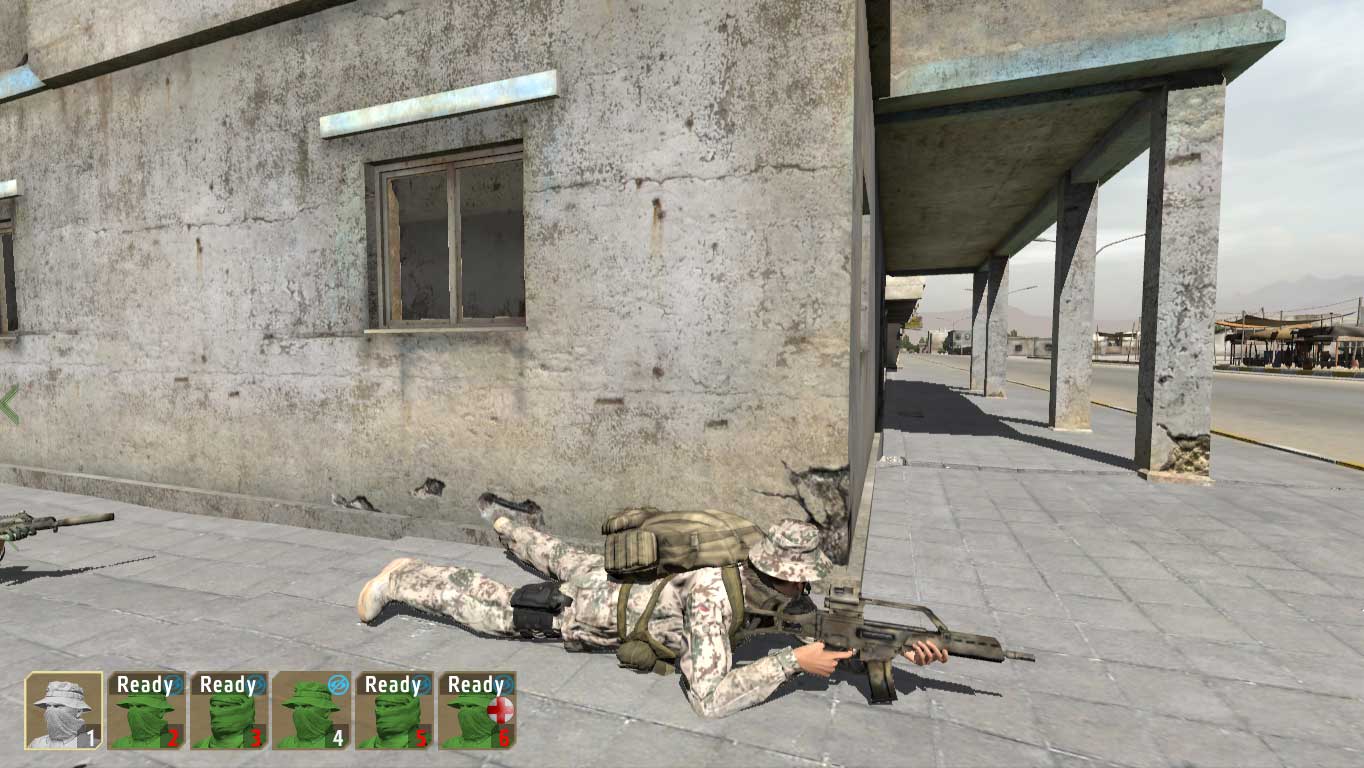
Today's mission: a German KSK special forces squad is returning from a successful snatch and grab at a urban area and now is attempting an exfiltration towards a linkup point eastward from their position. The squad featured in this mission is part of a platoon and the exfiltration is being conducted by squads. The enemy (insurgents) is slowly coming to grips about the raid and is setting up blocking positions wherever they can.
The German squad will attempt to move at or near streets to keep speed at a reasonable level.
![]() |
| Peeking east through "right street" reveals an enemy patrol reinforced with an APC. "Right Street" is a surface. |
![]() |
| Looking east down "left street". At least two enemy patrols in the distance with maybe a technical truck. "Left Street" is another surface. |
![]() |
| SITREP. Left and right streets are definitively surfaces. The question is: is the "center street" actually a gap? |
With the support team holding a house on the side of the center street, I carefully move east with my scout (#4).
![]() |
| Contact on the right flank. A heavy machine gun. I quickly dispatch it from my position without incident. Damn I love my rifle! |
![]() |
| Need a moment to think. I am watching towards my guys now (note the support team in the house across the "center street", green icons). We have no AT weapons, how are we going to take out this APC? |
I have no options but to try to snipe the APC gunner. Since the APC has no overhead armor, I may have a chance. I don't know how on earth I killed the heavy machine gunner before without throwing the enemy onto us, but this time I may not be that lucky and I want to have the whole squad ready to move out east once I take out the APC gunner.
![]() |
| I come back to my support team and organize them on the sides of the "center street". |
![]() |
| In situations like this, I hate being such a lousy shot. I got the APC gunner, though, and the vehicle moved away really fast. I was lucky that this vehicle was unsupported by infantry. |
It is time now to move the squad east and this is where I am going to stop the narrative and get back to the original point.
![]() |
| It all started with a clear tactical picture of "left" and "right" street as being surfaces. "Center" street, originally thought as a gap, ended up being a kill sack. |
Take home lesson:the physical absence of enemy in a piece of terrain doesn't guarantee a gap and any piece of terrain where the enemy has a field of fire is actually a surface.
Cheers,
Saturday, November 20, 2010
Maneuver Warfare: A Wargamer's Notebook - Introduction
This series of blog entries are about the so-called "maneuver warfare" as explained by William Lind. The writings of Robert Leonhard will also be included. I claim neither expertise in the subject nor devotion to this way of waging wars and thus, I am not trying to convert you into anything. This series is not an analysis or a review of all ideas about maneuver warfare but rather some explorations about the topic based on computer war games and simulations. Future entries will be delivered based in readership.
Much has been written and debated about maneuver warfare and chances are you heard about this before.As a said in the opening paragraph, this is not a review, analysis or tutorial about maneuver warfare. For a complete coverage of the ideas you will have to check out any of the literature available. I can recommend two books as a starting point.
Maneuver Warfare Handbook, by William Lind, is the book that I will be using as a premier source for this series of entries.
The Art of Maneuver, by Robert Leonhard, is a discussion of maneuver warfare in the context of the now defunct AirLand Battle doctrine. Leonhard is borderline genius in his explanation of the art of war and this book is no exception.
More books will be added to this list in future entries.
What is maneuver warfare? That's a difficult question.
Let's start with what is not. Maneuver warfare is sometimes confused with "fire and maneuver" (the tactical moving and positioning of weapon systems in order to deliver fires onto the enemy). Although maneuver warfare involves "fire and maneuver", the former is a more encompassing way of fighting.
In Maneuver Warfare Handbook, Lind comes a bit short of defining it in a formal sentence or paragraph. One gets the impression that Lind is not very fond of summing up a way of fighting in a single grammatical salvo. Waging wars shouldn't be about applying fixed recipes and drills, and his reluctance to deliver a single definition is replaced by thought provoking tactical narrative.
However, there is a common theme to all the scenarios that Lind explains and that is the focus in incapacitating the enemy's command decision process. That is not to say that destroying the enemy is the ultimate focus. After all, we want to kill the enemy, not just annoy him. But it is easier to defeat a foe whose decision process has been targeted early on.
Lind recognizes three major guidelines (he calls them "filters") to shape a battle plan:
Much has been written and debated about maneuver warfare and chances are you heard about this before.As a said in the opening paragraph, this is not a review, analysis or tutorial about maneuver warfare. For a complete coverage of the ideas you will have to check out any of the literature available. I can recommend two books as a starting point.
Maneuver Warfare Handbook, by William Lind, is the book that I will be using as a premier source for this series of entries.
The Art of Maneuver, by Robert Leonhard, is a discussion of maneuver warfare in the context of the now defunct AirLand Battle doctrine. Leonhard is borderline genius in his explanation of the art of war and this book is no exception.
More books will be added to this list in future entries.
What is maneuver warfare? That's a difficult question.
Let's start with what is not. Maneuver warfare is sometimes confused with "fire and maneuver" (the tactical moving and positioning of weapon systems in order to deliver fires onto the enemy). Although maneuver warfare involves "fire and maneuver", the former is a more encompassing way of fighting.
In Maneuver Warfare Handbook, Lind comes a bit short of defining it in a formal sentence or paragraph. One gets the impression that Lind is not very fond of summing up a way of fighting in a single grammatical salvo. Waging wars shouldn't be about applying fixed recipes and drills, and his reluctance to deliver a single definition is replaced by thought provoking tactical narrative.
However, there is a common theme to all the scenarios that Lind explains and that is the focus in incapacitating the enemy's command decision process. That is not to say that destroying the enemy is the ultimate focus. After all, we want to kill the enemy, not just annoy him. But it is easier to defeat a foe whose decision process has been targeted early on.
Lind recognizes three major guidelines (he calls them "filters") to shape a battle plan:
- Mission type orders: you can't defeat the enemy's tactical decision process if yours is very slow. Let your subordinates accomplish their mission or exploit opportunities as the see fit instead of waiting for your orders at every speedbump.
- Main effort or schwerpunkt: even when you don't want a battle-group of robots that wait for every detailed instruction, you don't want a circus where every captain thinks is an army group commander either. Your battle plan should have a point of main effort to glue all your subordinates' tactical actions
- Surfaces and gaps: this one is very simple, put your strength onto the enemy's weaknesses.
Cheers,
Subscribe to:
Posts (Atom)